Kubernetes
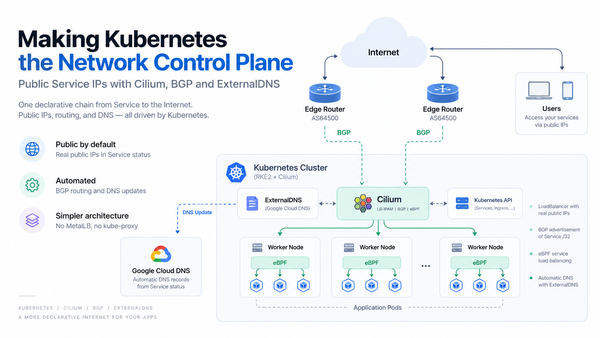
Making Kubernetes the Network Control Plane: Public Service IPs with Cilium, BGP and ExternalDNS
Moving the public identity of a service into Kubernetes, from address allocation and route advertisement to packet forwarding and DNS.
Kubernetes
Moving the public identity of a service into Kubernetes, from address allocation and route advertisement to packet forwarding and DNS.
Kubernetes
Step-by-step guide to deploying a highly available Kubernetes cluster on-prem using kubeadm. Covers CoreDNS setup, external etcd with SRV discovery, HAProxy + KeepAlived API load balancing, and Calico networking (iptables → eBPF). Includes configs, verification, and best-practice automation tips.

Kubernetes
Prometheus failed to scrape metrics due to missing RBAC permissions. This guide explains the symptoms, diagnosis, and fix using Role and RoleBinding, with YAML examples and logs for reference.
Kubernetes
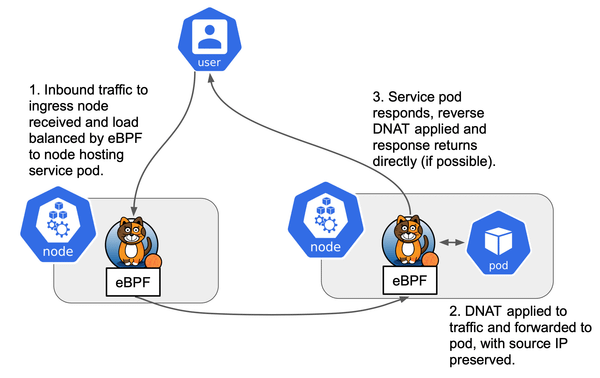
This article explores the challenges of deploying Calico in eBPF mode for Kubernetes, focusing on issues like the need for an external load balancer, VIP certificate configurations, and circular dependencies when the control plane fails. Solutions for these challenges are also discussed.
Kubernetes
MetalLB (controller-only) with Calico BGP does not bind VIPs to any node interface, causing ARP failures. Services stay unreachable externally. Solution: locally bind VIPs, enable strictARP, and disable rp_filter to restore correct traffic flow.

Kubernetes
This article examines how to build a self-hosted Kubernetes cluster on bare-metal infrastructure, focusing on networks, high availability, DNS, and storage. It targets academic infrastructure engineers managing clusters under 50 nodes, contrasting with managed cloud solutions.

Kubernetes
Deploy MetalLB as controller-only and let Calico’s BGP advertise a LoadBalancer pool. The guide covers Helm setup, IP pool config with avoidBuggyIPs, route flow analysis, source-IP-preserving Local policy, and failover tests for production-grade bare-metal LB.
Notes
这篇博客将向您介绍如何使用 GitHub CI 自动将 Docker 镜像推送到 Google Artifact Registry(GAR)的自动构建仓库。 GitHub CI 的功能使得代码推送到 GitHub 仓库时,能够自动构建 Docker 镜像并推送到 GAR。这种自动化流程有助于提高了开发效率,同时还可确保在发布新版本时代码和镜像的一致性和可靠性。 本文将为您提供详细的步骤和指南,帮助您轻松实现自动构建和推送 Docker 镜像的流程。 相关服务介绍 在本章中,我们将简要介绍 Google Artifact Registry 和 IAM 的 Service Account 授权模式的概念和特点,以便读者更好地理解如何使用它们来构建和管理 Docker 镜像。我们还将介绍 Artifact Registry 和 IAM Service Account 之间的关联,并讨论如何创建和配置

Essay
主要使用工具的介绍 在本节中,我们将介绍 Kubernetes 和 Helm 的基本概念,这些知识是理解如何在 Kubernetes 集群上部署 WordPress 的基础。 Kubernetes 简介 Kubernetes 是一个开源的容器编排平台,用于自动化容器的部署、扩展和管理。Kubernetes 提供了一个统一的 API 和工具,使得容器的部署和管理变得更加简单和可靠。它可以管理运行在多台机器上的容器,确保容器应用程序的高可用性、弹性、伸缩性和安全性。 Kubernetes 主要包括以下核心概念: * Pod:Kubernetes 中最小的可部署单元,包含一个或多个紧密关联的容器。 * Deployment:用于管理 Pod 的副本数量和更新。 * Service:用于暴露 Pod 或 Deployment 在集群内部和外部的网络地址。 * Volume:用于将持久化数据挂载到容器中。 * Namespace:用于将 Kubernetes 资源进行逻辑上的隔离和分组。 Helm